How warm were
my words today?
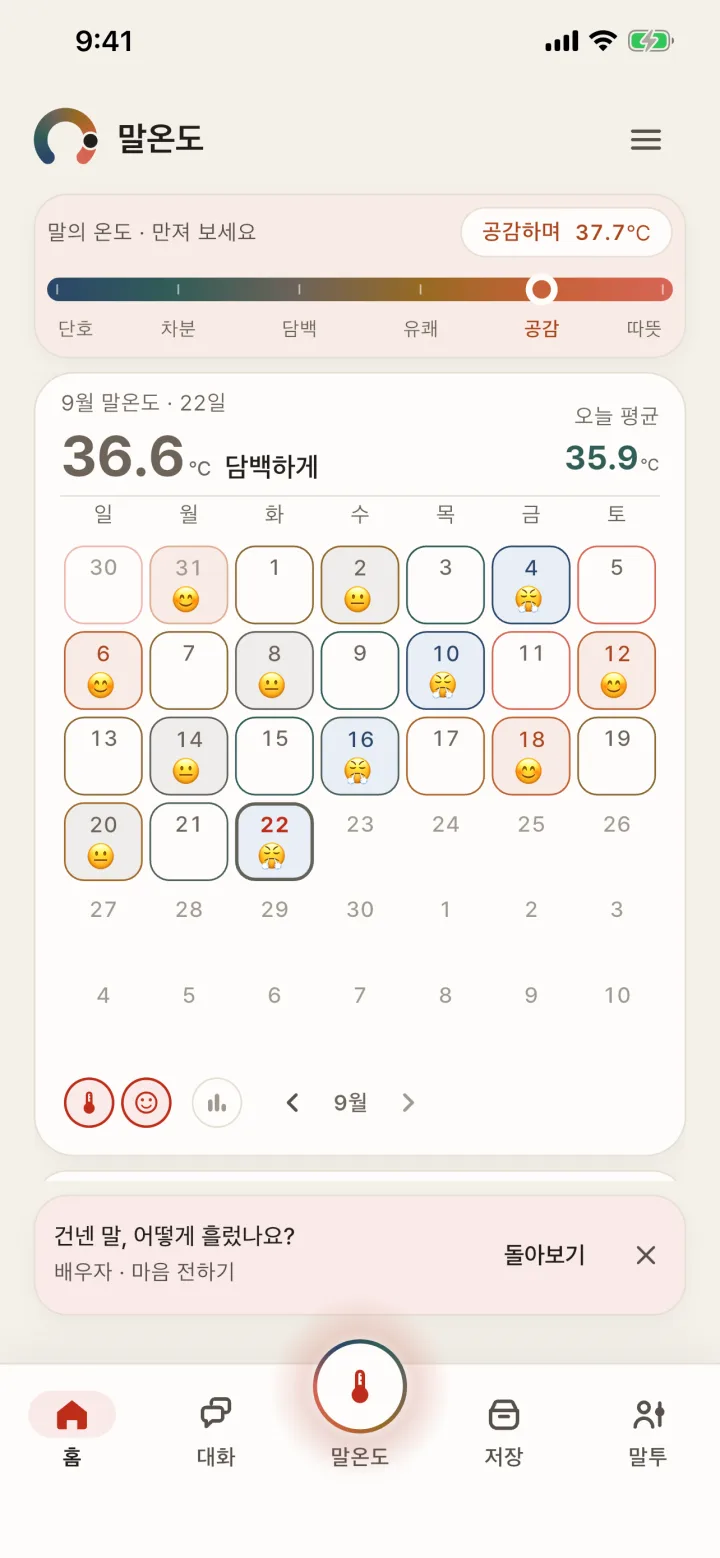
Each day's temperature settles into the calendar
 Malondo
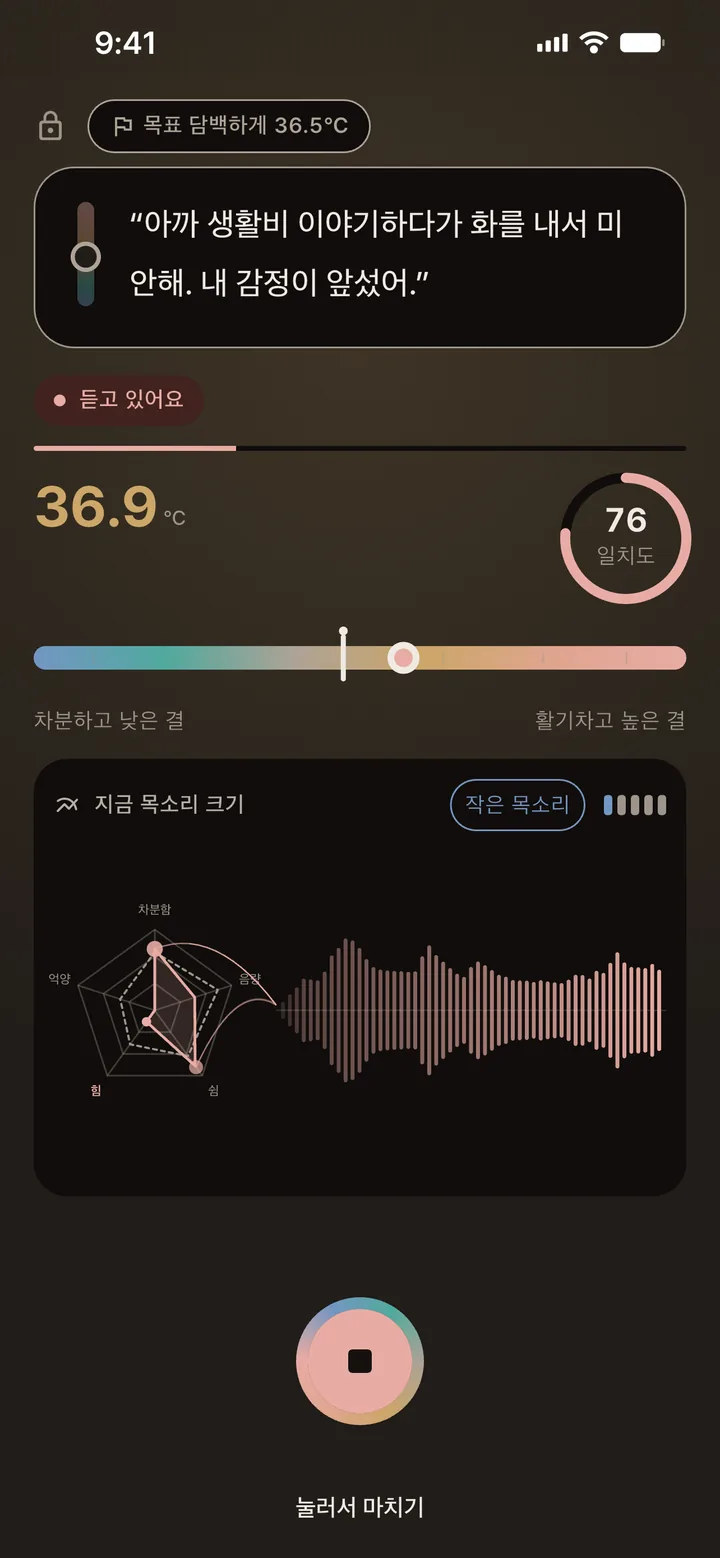
For the moments when talking is hard, Malondo helps you find the one or two sentences to say to this person, right now. It reads the pitch, pace, pauses and loudness of your voice on your device and measures the temperature of your words.
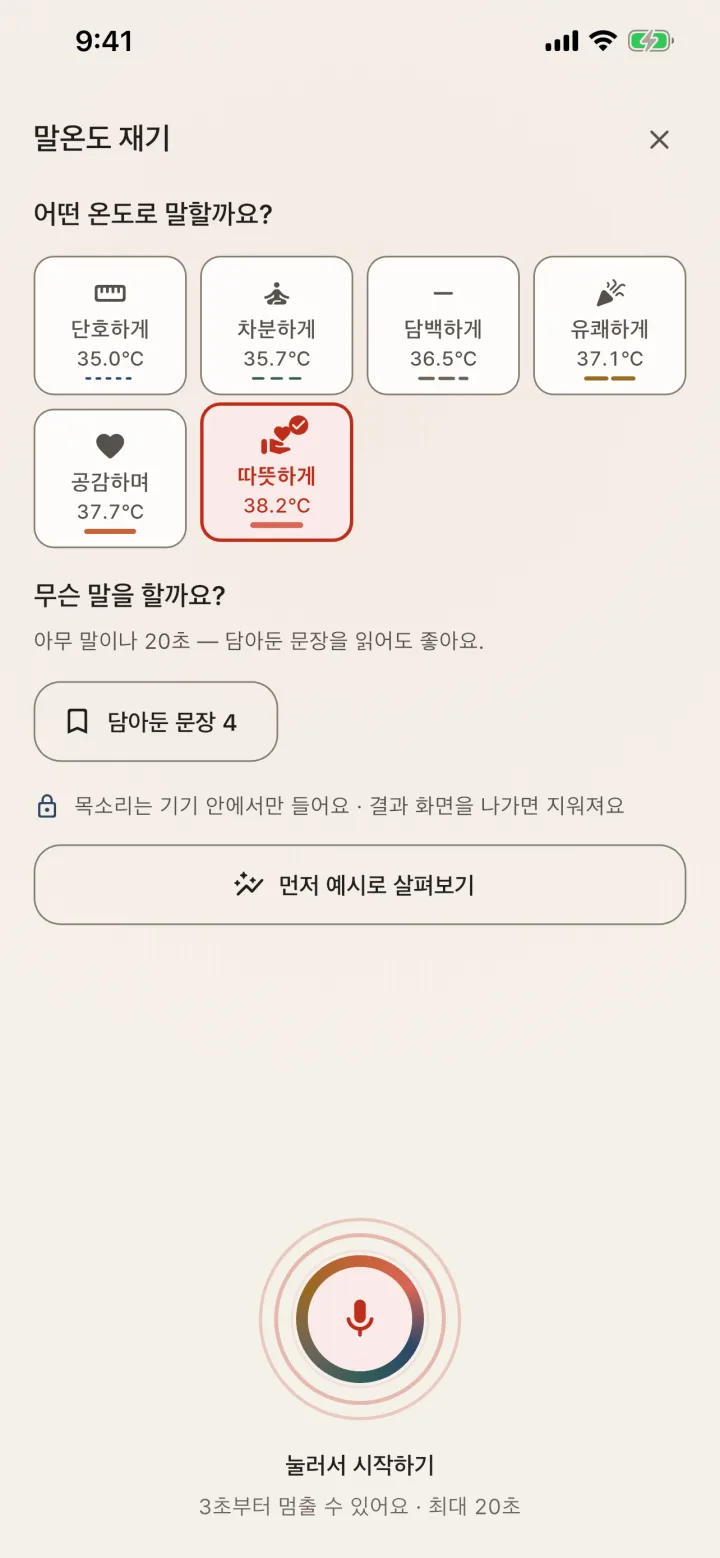
Six tones sit on one line. Plain, at 36.5℃, is the origin, and while you speak the needle moves like this.
Those one or two sentences are what Malondo thinks through with you. It never sends anything for you. You choose, shape it in your own words, and send it yourself.
Swipe through. Thirteen scenes.
Each day's temperature settles into the calendar
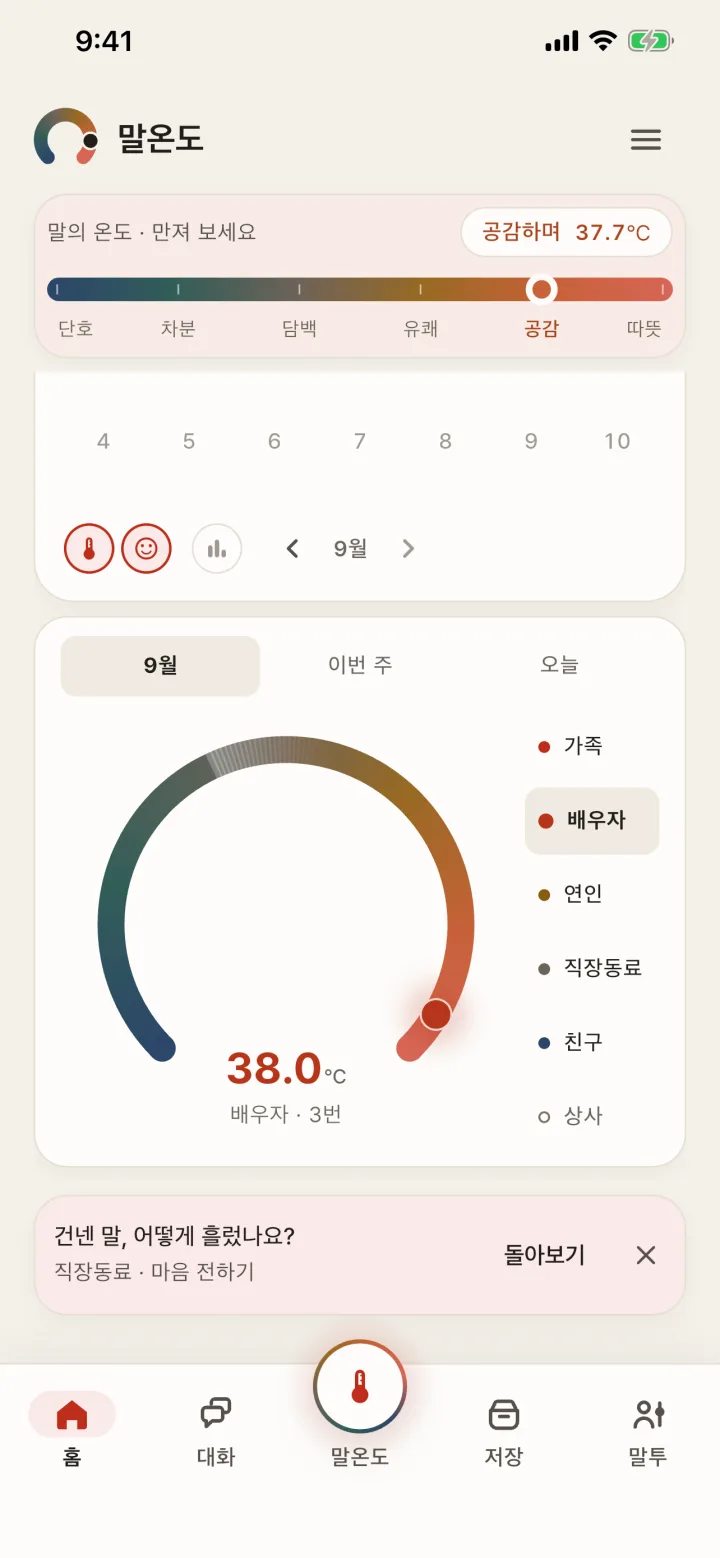
This month, this week and today on one card
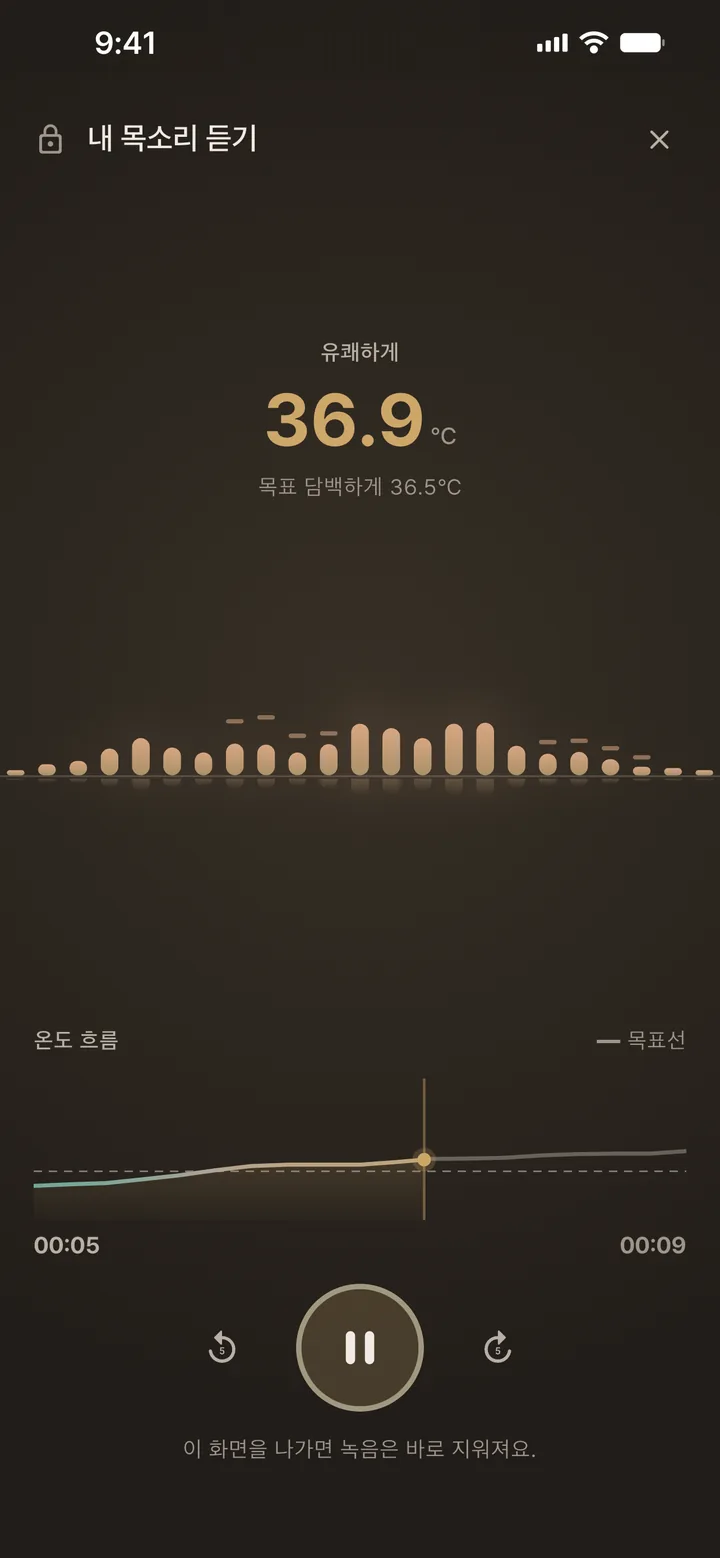
Your voice is heard only on your device
You see at once whether you're cooler or hotter than the target
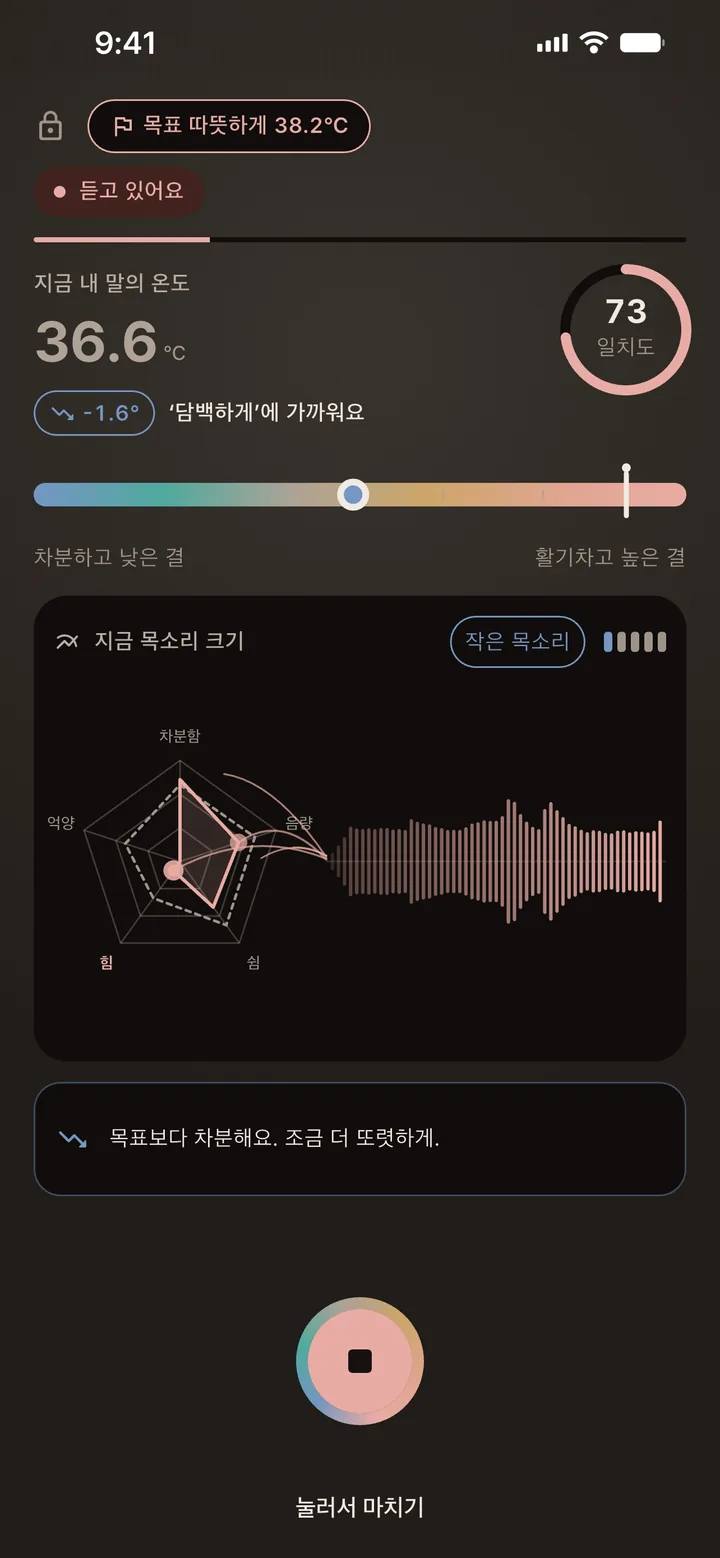
Five axes, from steadiness to speech and pauses
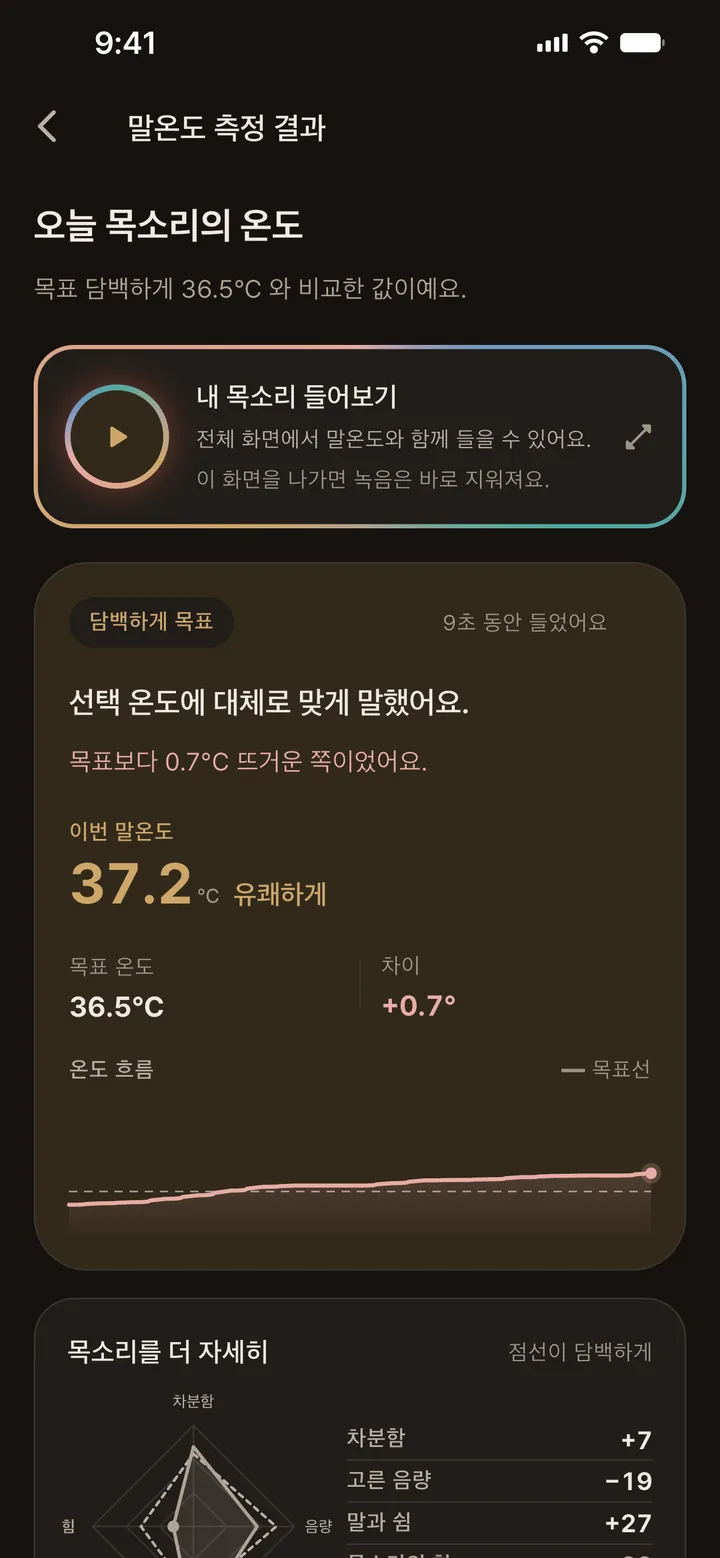
The recording is deleted the moment you leave
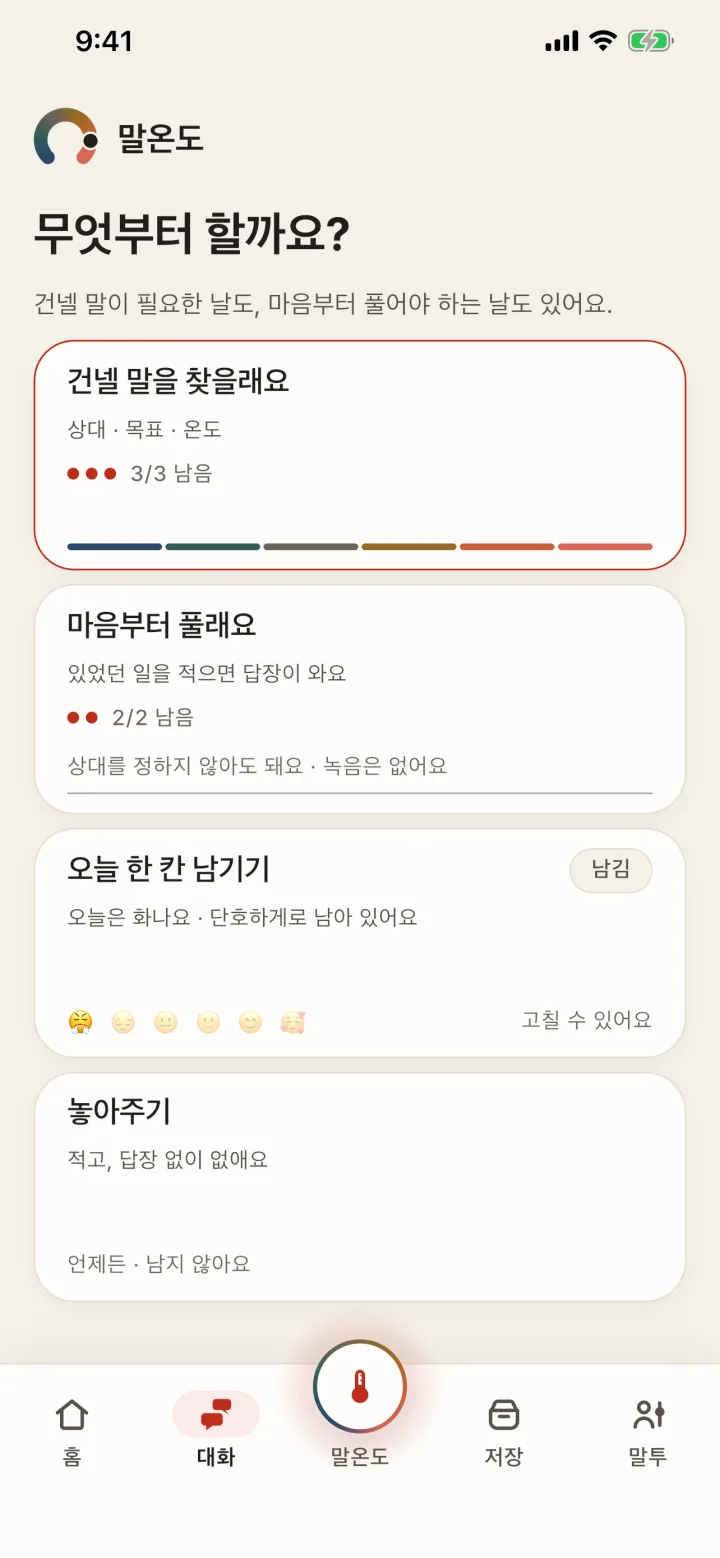
The Talk tab opens four ways
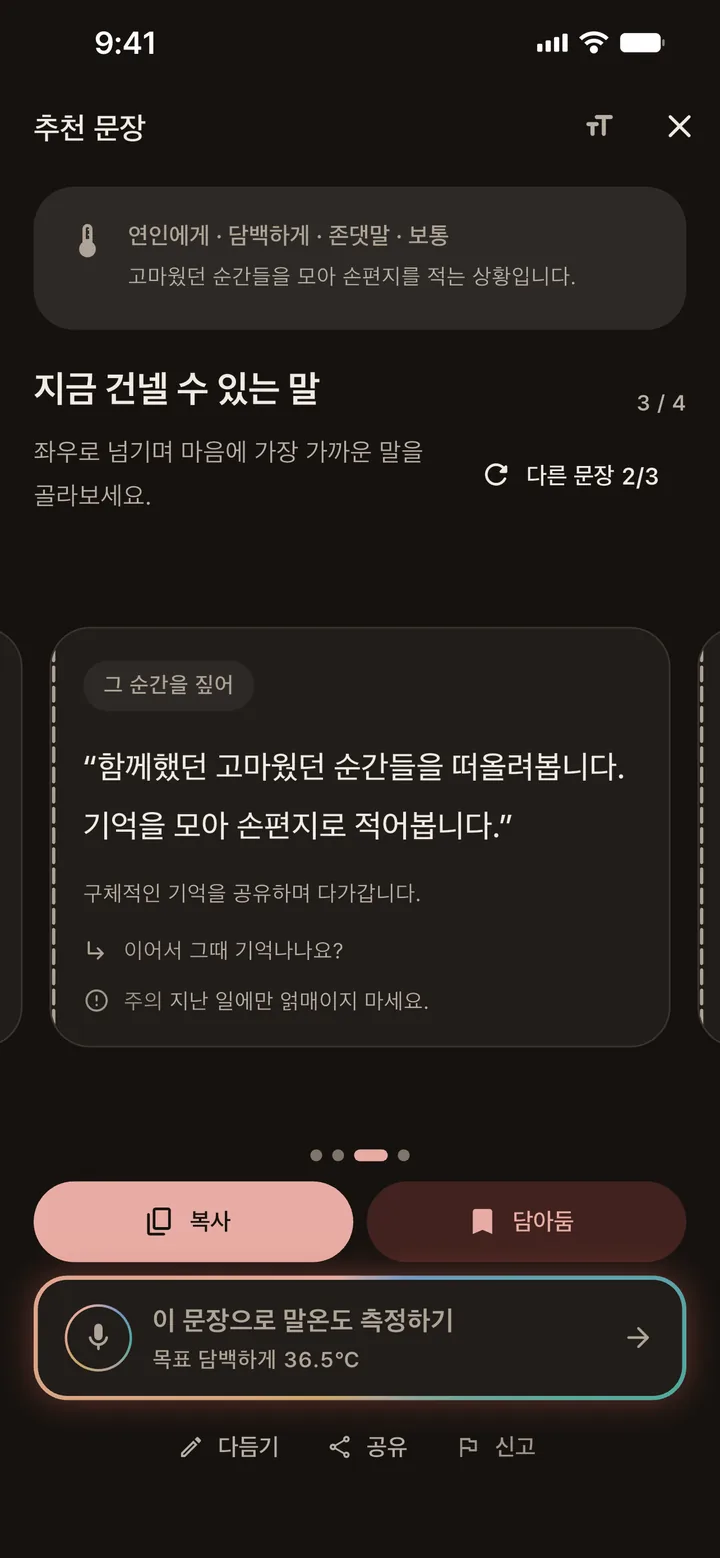
Four sentences fitted to the situation and the temperature
Speaking practice at the target temperature
Nothing you write here is kept
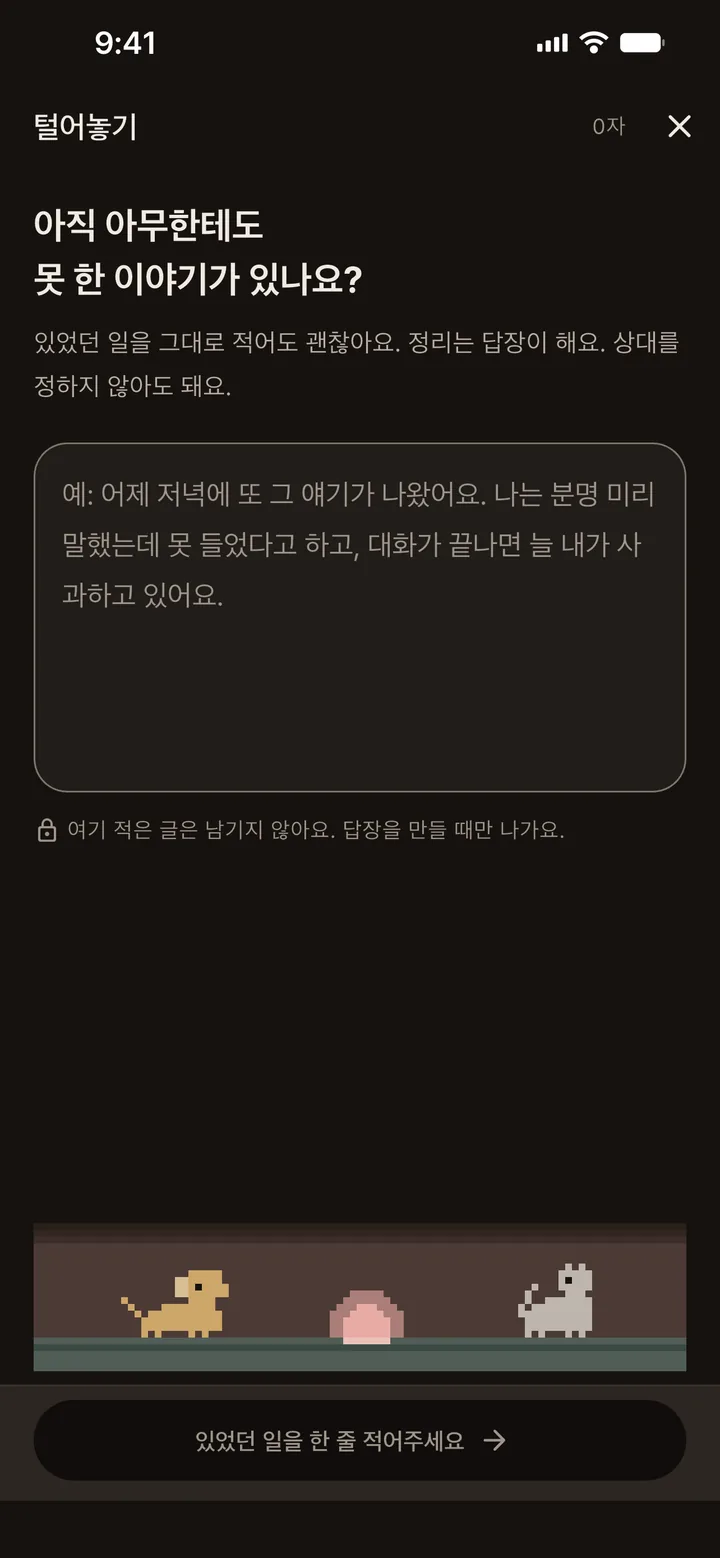
The text is never written to a file
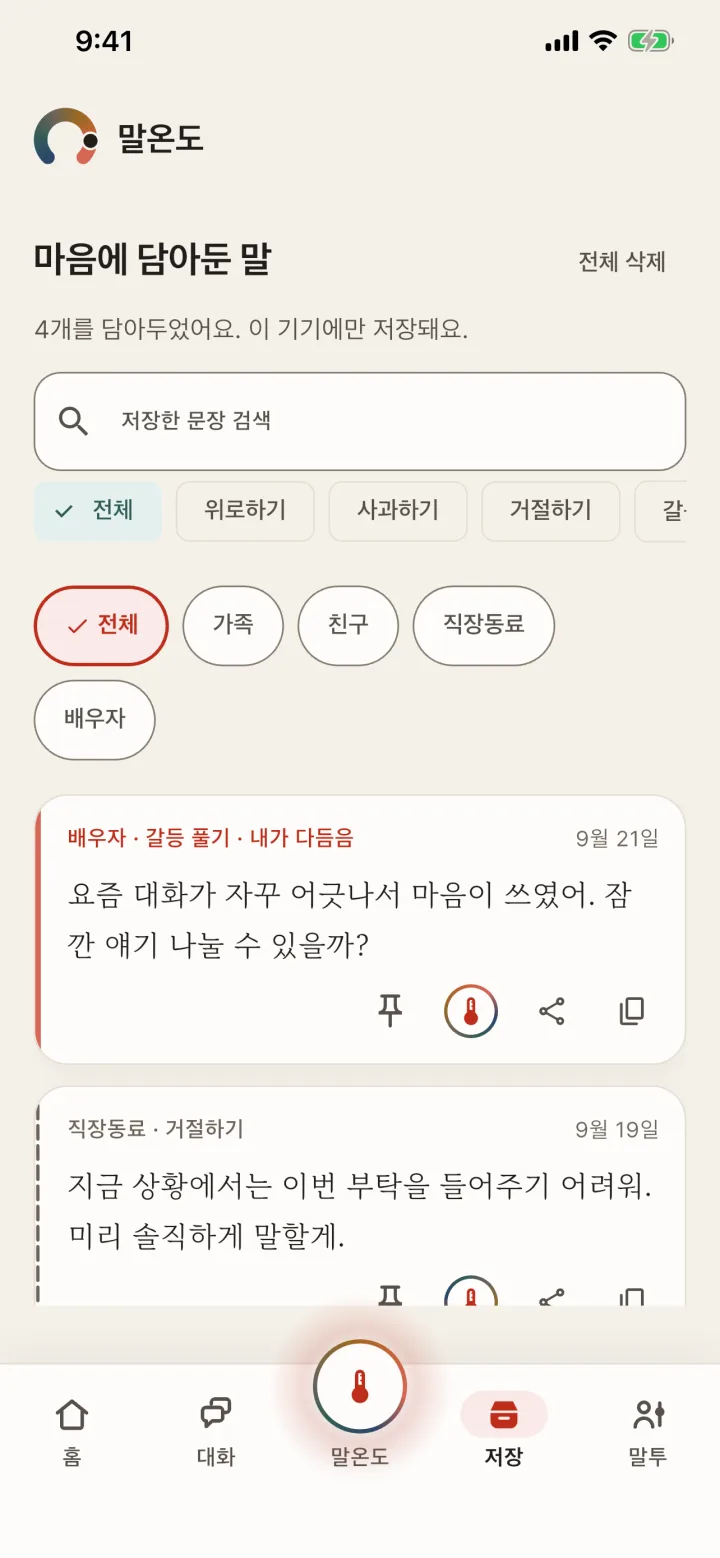
Filter by person, search the text, pin the ones you use most
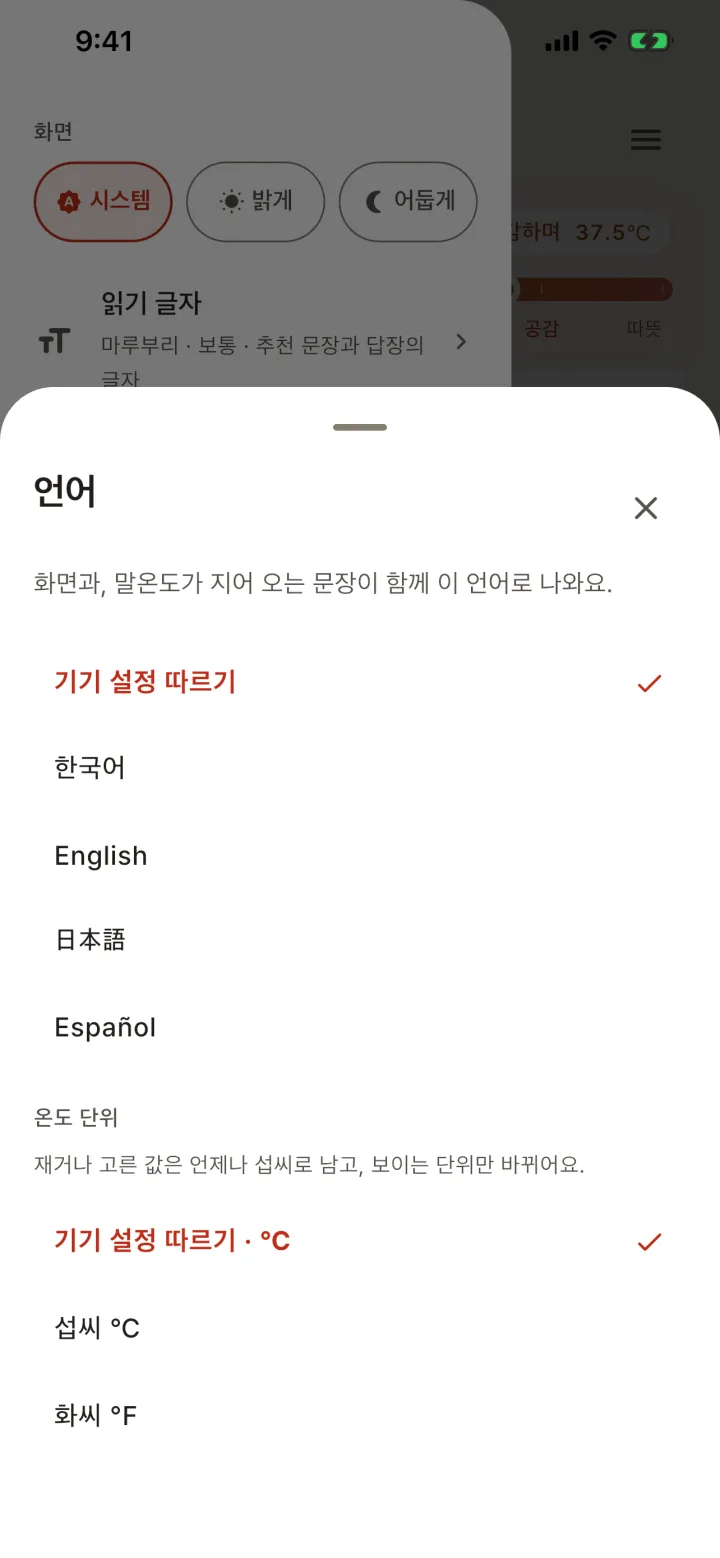
The screen and the sentences it writes, in your language
To this person, in my own voice, what one or two sentences should I say?
A favour, a refusal, an apology, comfort, a conflict. The words are already in you, but the first sentence won't come, and you sit with the window open for far too long. That is the moment this is for. The app never sends anything for you. You choose, shape it in your own words, copy it, and send it yourself.
한국어 · English · 日本語 · Español. By default it follows your device, and you can change it in the drawer under Language and units.
Tap a phone and this page switches to that language too.
The four sentences, the letter, the daily reminder and the home widget all come in the language you chose. Register — formal and informal, です・ます — follows each language's own grammar. What you wrote yourself is never translated; it stays exactly as you typed it.
Every value you measure or choose is always stored in Celsius; only what you see changes. So switching units leaves your history untouched. You can try it on this page too.
Six tones, each given a temperature from cool to warm. Plain, at 36.5℃, is the origin. Move left and the words cool; move right and they warm. The temperature you pick when choosing a sentence and the one measured from your voice share the same six stops and the same scale, so you can compare them directly.
Inside the app, temperature is never carried by colour alone. Colour, number, name and the shape of the line all speak together.
While you record, the needle looks at the last 4.5 seconds and moves on any sound that rises above the room's noise floor. When you stop, the whole take is measured once more and that value is kept. All that remains per take is one temperature and a timestamp.
It reads one frame every 70 ms. Each frame carries the loudness (dBFS), the pitch found by autocorrelation (Hz), the share of the voice band (300–3400 Hz), and seven 10 ms loudness values inside the frame.
It tracks the room's noise floor throughout the recording and measures whatever rises above it. Where the voice band and the 3-to-5-per-second rhythm of syllables appear together, it marks speech and reads pitch only there. From the frames that remain, the room's share is subtracted.
Before any scoring, it measures in the units people use. Pitch range is the spread in semitones around your own middle pitch, so high and low voices share one scale. Pace is the number of peaks separated by dips in the 10 ms loudness (the vowels of syllables) divided by the time sound was heard; pauses are the silent share from the first word to the last; loudness is the room-subtracted average, and even volume is its spread.
All five values go onto 0–100 by one rule. 50 is the median of 226 Korean readings (FLEURS) and one interquartile range is 25 points. So the middle half of ordinary reading falls between 37.5 and 62.5, and the references of the six tones stand inside the range people actually produce. Only the “usual” pitch follows the voice reference in the Tone tab (Default · Male · Female).
Word temperature is the weighted sum of the five scores. Pitch decides most of it; loudness cools it a little (the louder and crisper, the closer to Firm); pauses warm it a little. Pace and even volume don't move the temperature — they only tell which of the six tones you are closest to, the shape of your texture. Because it is a sum, each measure pushes one way only, and the result always stays within 34.7℃–38.5℃.
Within 0.45℃ of the target counts as on target. Even the same person reading the same way varies from sentence to sentence, and a 15-second take wobbles by about 0.44℃ (one standard deviation) — so one reading is not used to separate neighbouring tones. Off target, it suggests the one measure with the largest weight × points left to the target. Each weight points one way only, so following the suggestion always moves the temperature toward the target.
36.5℃closest to Plain
| Axis | Plain | Ordinary voice |
|---|---|---|
| Calm pace | 50 | 45 |
| Even volume | 50 | 67 |
| Speech and pauses | 50 | 53 |
| Vocal strength | 50 | 50 |
| Pitch | 50 | 49 |
| Tone | ℃ | Calm pace | Even volume | Speech and pauses | Vocal strength | Pitch |
|---|---|---|---|---|---|---|
| Firm | 35.0 | 50 | 75 | 38 | 75 | 20 |
| Calm | 35.7 | 75 | 75 | 62 | 25 | 23 |
| Plain | 36.5 | 50 | 50 | 50 | 50 | 50 |
| Light | 37.1 | 25 | 25 | 31 | 69 | 72 |
| Caring | 37.7 | 69 | 62 | 69 | 38 | 75 |
| Warm | 38.2 | 62 | 50 | 56 | 38 | 89 |
Exactly the constants the app carries. Plain is ordinary reading (all five at 50); the other five were moved ½–1½ interquartile ranges in the direction their names describe, then their pitch value was solved from the temperature formula. How far they were moved is still a judgement, not a measurement.
| Measure | What is measured | 50 points (median) | 25 points (IQR) |
|---|---|---|---|
| Calm pace | Pace — counted syllables/s, slower is higher | 5.24 | 0.56 |
| Even volume | Loudness spread — smaller is higher | 7.46 dB | 2.19 dB |
| Speech and pauses | Pause share — more is higher | 0.099 | 0.107 |
| Vocal strength | Room-subtracted average loudness | −42 dBFS | 6 dB |
| Pitch | Pitch range (semitones) | Male 2.56 Default 2.84 Female 3.12 | Male 0.63 Default 0.69 Female 0.56 |
Measured with the app's own code on 226 Korean readings from FLEURS (CC-BY-4.0), each first set to an average of −42 dBFS. The corpus can't say what 50 points of loudness is, so −42 dBFS — the middle of what a phone held in the hand records in a quiet room — was set, with 25 points = 6 dB, the drop when the phone moves twice as far away. Pace counts about 0.8 of the real syllables, because syllables without a final consonant that run together merge into one; the scale was measured the same way, so that share cancels out.
Your voice never leaves the device. Loudness and frequency analysis happen entirely on it, and all that remains per take is one temperature and a timestamp. There are four ways anything leaves, and the app's data sheet shows the same list.
Not storing and not sending are different promises, so the complete list of what leaves is in the privacy policy.
An AI conversation coach for the moments when talking is hard. When the first sentence of an apology, a refusal, a request or a word of comfort won't come, it suggests four ways to say it to this person, right now. Speak out loud for about twenty seconds and it also measures the temperature of your tone of voice. It's free and needs no account.
The same words can land cold or warm depending on how you say them. Malondo gives that texture a temperature: Firm 35.0℃ · Calm 35.7℃ · Plain 36.5℃ · Light 37.1℃ · Caring 37.7℃ · Warm 38.2℃. The six tones sit on one line, so the temperature you pick for a sentence and the one measured from your voice share the same scale. It's a metaphor for how your words come across, not your body temperature.
In 'I want to find what to say', choose who (Spouse · Partner · Family · Friend · Coworker · Boss), what (Apologise · Say no · Ask a favour · Comfort · Ease a conflict · Say how I feel · Give my view) and in which tone, then write a line or two about what happened. Four sentences arrive, each taking a different road, and every card says why it speaks this way, what to say when they answer, and what to watch out for. Something you already wrote can go through 'Rework my sentence': the meaning stays and only the phrasing changes.
Yes. That's what Ease a conflict, Comfort and Say how I feel are for. It doesn't write sentences to win or to persuade, but sentences that carry your feelings and your boundaries together, and Practise lets you walk through what may come next. The app never sends anything for you. You choose, shape it in your own words, copy it and send it yourself.
In Measure, speak out loud for about twenty seconds. Malondo reads the pitch, pace, pauses and loudness of your voice on your device and measures the temperature of your words. While you talk you see how close you are to the target temperature you picked, and at the end a fingerprint lays your voice over the target on five axes to show where they part. Instead of a score it names one thing to try next, so it also works as speaking practice: read a suggested sentence aloud and soften your tone.
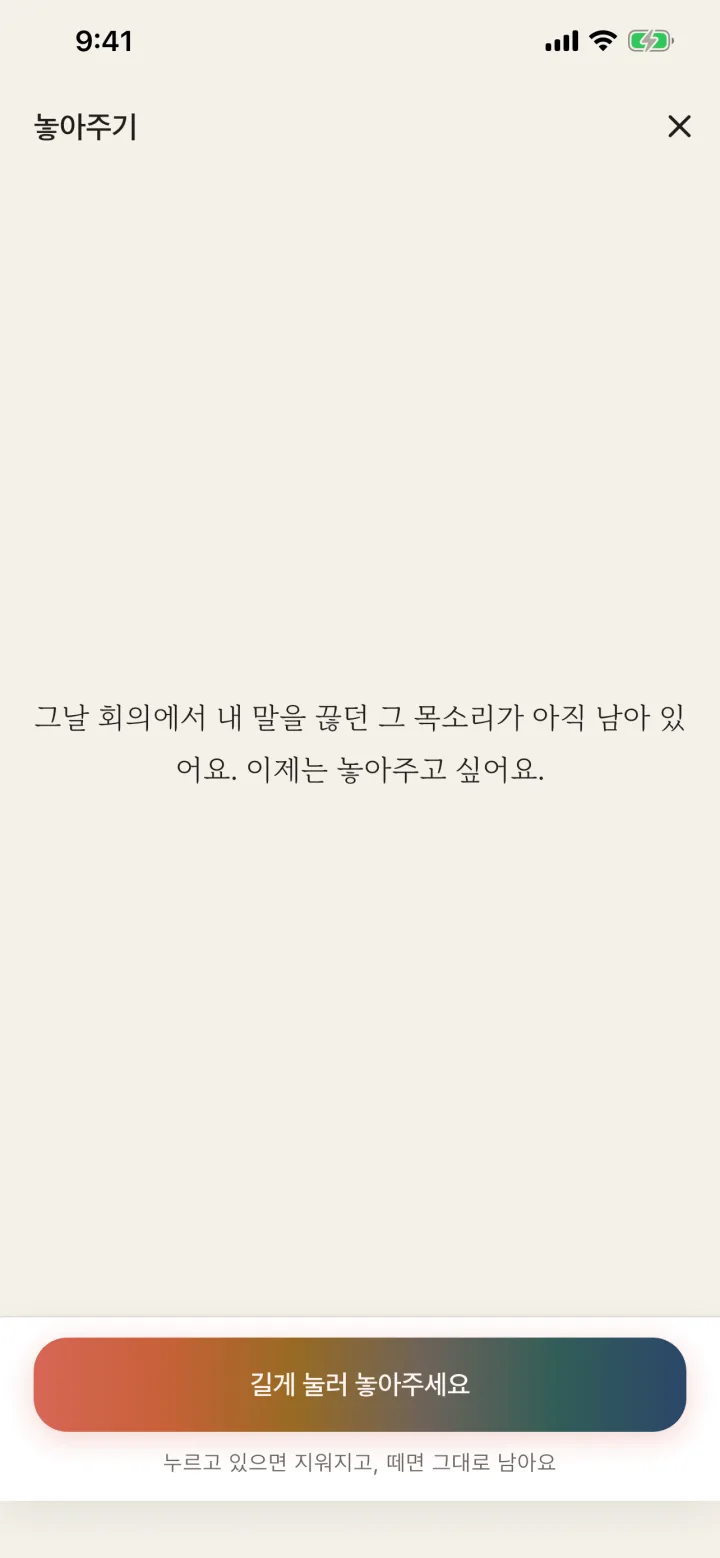
In 'Unwind first', write what happened and choose only what kind of answer you need (Just listen · Help me sort it out · Show me another angle · Tell me what to do · What's mine to carry), and a letter comes back. Neither what you wrote nor the reply is kept. On days you don't need a reply, Letting go lets you write one thing that has stayed too long, in a hundred characters or fewer, and erase it by hand, and Today's square keeps how you felt on the calendar.
Your voice never leaves the device. All analysis happens on it, and the recording is deleted as soon as you leave the result screen. There's no sign-up, and the situations you write and the sentences you receive are not kept on a server. Only while sentences or a letter are being made do the situation you wrote and the relationship, goal and temperature you picked go to Google Gemini. The full list of what leaves is in the privacy policy.
It's free, with no in-app purchases. You get three rounds of suggested sentences and two letters a day, and on days you use them up you can choose to watch one rewarded ad to refill. Letting go and Today's square have no limits and no ads.
No. Malondo is not a medical or counselling service, and it does not diagnose emotions, personality or relationships. When signs of self-harm or violence are read, guidance and helpline numbers come before any suggestion.
Right now you can get it on iPhone (App Store); Android (Google Play) is on the way. Screens and suggested sentences come in 한국어 · English · 日本語 · Español, and temperatures can be shown in ℃ or °F.
No in-app purchases. The only ad is one rewarded ad you open yourself, on days you've used up the daily allowance. Available in 한국어 · English · 日本語 · Español.
If something gets in your way, or there's something you wish it did, tell us on the support page.